
The first five minutes of a film are its opening argument. They are supposed to set the tone, establish the world, and make a case for why you should dedicate the next two hours of your life to it. Most modern blockbusters make their case with the frantic energy of a fun-filled CGI presentation full of explosions—a sensory assault designed to look impressive in a trailer and be forgotten by the time you've finished your popcorn.
Then there is the opening of The Dark Knight.
It is not an assault. It is a surgery. It is a cold, calculated, and terrifyingly coherent masterclass in narrative efficiency. It's so good, it almost feels arrogant. Let's deconstruct the impeccable, beautiful logic of a perfect opening.
The Analysis of Pacing & Tension

// Every operation requires a point man. Note the calculated patience; the chaos is on a strict schedule.
The brilliance here is not in what’s loud, but what’s quiet. From the first percussive thump of Hans Zimmer’s score, a sense of dread begins to build. It’s not the jump-scare feeling of a horror movie; it’s the quiet, administrative dread of an unopened letter from the tax office. You don't know exactly what's inside, but you know it's meticulously organized and not in your favor. Christopher Nolan edits the sequence to the rhythm of a stopwatch—every cross-cut, every zip-line, every gunshot is a tick, and you get the distinct feeling that this is all leading to a final, deafening tock.
The Character Introduction: The Joker

// Asset unmasked. The only remaining liability is the bus driver's impending therapy bill.
We don't meet The Joker in this scene; we receive a brutally effective corporate orientation on his business philosophy. Before he says a single coherent word, we understand his entire operational model through the actions of his crew, who are both employees and expendable assets.
His plan, a pyramid scheme of murder that rewards loyalty with a bullet to the back, is a brutally efficient HR policy, if you think about it. It solves the problem of splitting the final take by ensuring there's almost no one left to split it with. It's a masterclass in downsizing. By the time he calmly reveals himself to the last surviving bank manager—and, one assumes, ruins that bus driver's entire day—his goal is clear. The money is just a tool. The real prize is the meticulous execution of a chaotic idea.
The Thematic Introduction: The Big Idea

// Subject believes the old rules still apply. He is about to be aggressively corrected.
This was never about stealing the mob's aggressively non-liquid assets. It was a hostile takeover of Gotham's entire criminal underworld, and this heist was the opening presentation to the board. The mob, bless their simple, profit-driven hearts, think they're dealing with a higher class of thief. The bank manager, clinging to a world with rules, sputters that criminals "used to believe in things." He has no idea he's just met his new, terrifyingly effective management consultant.
The Joker is here to streamline the entire operation. His only deliverable is anarchy. His final line in the scene, "I believe whatever doesn't kill you simply makes you... stranger," isn't just a clever quip. It's the mission statement for the new company that's about to liquidate every criminal enterprise in the city.
The Craft: Why It Feels Real

// Case study in tangible impact. No pixels were harmed in the making of this sequence.
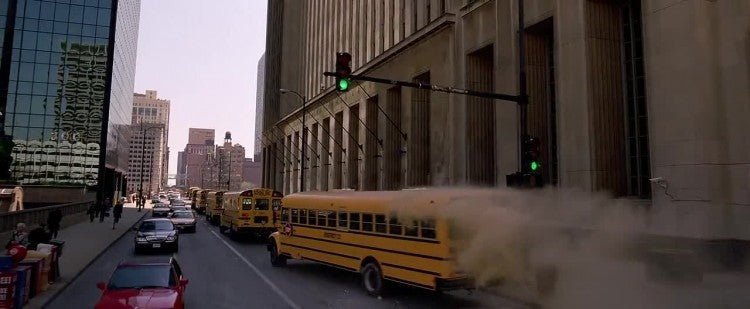
In an era of weightless CGI, this scene has gravity. Christopher Nolan's obsession with practical effects means that when a school bus plows through a bank wall, a real school bus plows through a real wall. There's a certain glorious, tangible chaos to it that no amount of perfectly rendered pixels can replicate. It's the kind of stunt that makes insurance agents wake up in a cold sweat, and it is beautiful.
This commitment to reality, captured with stunning clarity on IMAX film, grounds the Joker's fantastical plan in our world. It makes the threat feel not just cinematic, but possible.
The heist is a perfect film within a film. It tells a complete story with a beginning, a middle, and an end, all while setting up the larger story to come. It’s a flex—a declaration from a supremely confident filmmaker that you are in good hands.
What other opening scenes belong in the Bureau's archives? File your reports—the more detailed, the better—in the comments below.